


 Written By:
 Edited By:
 Clinically Reviewed By:

Meth Psychosis: Symptoms, How Long It Lasts, and When to Get Help
Meth psychosis is a potentially serious psychiatric reaction to methamphetamine use in which a person develops symptoms such as paranoia, delusions, hallucinations, or severely disorganized thinking. It can occur during meth intoxication, after repeated use, or around the period when meth use stops—and symptoms do not always disappear as soon as the drug’s immediate effects wear off.
For someone experiencing these symptoms, the episode can feel completely real. For a partner, parent, or friend, the change may be sudden and difficult to interpret: a person may become convinced they are being watched, hear voices no one else hears, see or feel things that are not present, or react defensively to perceived threats.
Methamphetamine is a powerful stimulant, but this guide is intentionally focused on meth psychosis, rather than the broader effects of meth use. If psychotic symptoms are happening now—especially alongside severe agitation, suicidal behavior, violence, seizures, chest pain, extreme overheating, or loss of consciousness—seek emergency medical care rather than attempting to manage the situation alone. Current addiction-medicine guidelines recommend urgent medical and psychiatric evaluation when stimulant-related psychosis is severe or escalating.
What Is Meth Psychosis?
Meth psychosis is a state of impaired reality testing associated with methamphetamine use, most often involving hallucinations, delusions, paranoia, or disorganized thoughts and behavior.
Clinicians may describe it as methamphetamine-induced psychosis, meth-induced psychosis, methamphetamine-associated psychosis, or stimulant-induced psychosis. It does not mean that every person experiencing it has schizophrenia.
Research has found that psychotic symptoms are relatively common among people who use methamphetamine, although prevalence estimates vary considerably depending on the population studied and how psychosis is defined. Importantly, meth-related psychotic symptoms can occur in people who have never previously experienced psychosis.
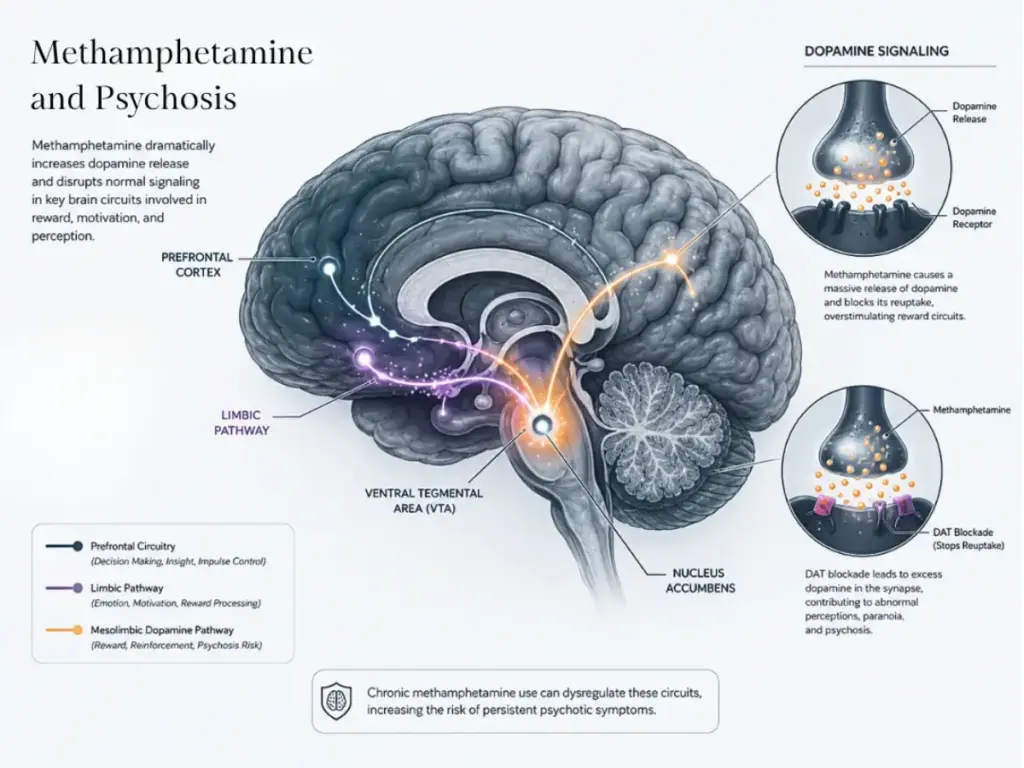
The relationship between meth and psychosis is complex. Meth strongly affects dopamine and other neurotransmitter systems, while factors such as repeated exposure, sleep deprivation, psychiatric vulnerability, stress, and use of other substances may also influence whether psychosis develops.
What Are the Symptoms of Meth Psychosis?
The most recognizable meth psychosis symptoms are intense paranoia, hallucinations, delusions, disorganized thinking, and behavior driven by beliefs or perceptions that other people do not share.
Symptoms can include:
- Paranoia or persecutory beliefs: believing people are following, watching, recording, plotting against, or trying to harm them.
- Hallucinations: hearing voices, seeing people or objects that are not there, or experiencing unusual physical sensations.
- Tactile hallucinations: feeling crawling, touching, or movement on or beneath the skin despite no physical cause being present.
- Delusions: firmly believing something despite strong evidence that it is not occurring.
- Disorganized thought, speech, or behavior: rapidly shifting ideas, difficulty following a conversation, unusual connections between unrelated events, or behavior that appears confusing to others.
- Severe agitation or fear: particularly when paranoia makes ordinary surroundings or familiar people seem threatening.
Visual and tactile hallucinations appear to be especially prominent in acute meth-induced psychosis and may occur more frequently than they do in schizophrenia, although no single symptom can reliably determine the diagnosis.
What Does Meth Psychosis Look Like in Real Life?
An active episode may look less like obvious “hallucinating” and more like a frightened person responding logically to something that only they can perceive.
This distinction matters for families.
Someone experiencing meth psychosis might repeatedly look through blinds because they believe someone is outside, cover cameras because they think they are being monitored, become suspicious of a partner they normally trust, whisper because they believe someone is listening, or suddenly interpret ordinary noises, vehicles, social media posts, or strangers as personally significant.
Another person may appear intensely preoccupied with their skin because of tactile hallucinations. Someone hearing voices may answer questions directed at a person no one else can see. Others may become increasingly difficult to follow in conversation as thoughts become fragmented or associations become unusual.
Not every unusual behavior after meth use is psychosis. Anxiety, intoxication, prolonged wakefulness, and stimulant withdrawal can also produce significant behavioral changes. What makes psychosis particularly concerning is the loss of reliable reality testing—especially hallucinations or fixed false beliefs.
A person may also have limited awareness that anything is wrong. For that reason, statements such as “you are imagining this” or attempts to prove a delusion false may not resolve the situation and can sometimes increase defensiveness. Clinical guidelines favor calm verbal and nonverbal de-escalation and a low-stimulation environment while appropriate medical care is arranged.
Can Occasional Meth Use Cause Psychosis?
Yes. Meth psychosis is more strongly associated with frequent, heavy, or binge-pattern use, but it is not limited to people with long-standing meth addiction.
There is no reliable amount of illicit meth that guarantees someone will or will not experience psychosis. Individual vulnerability varies, and illicit drug potency or contents may also be uncertain.
Risk appears higher with heavier or more frequent meth exposure, sleep deprivation, psychiatric vulnerability, family history of psychotic illness, and concurrent substance use. People with an existing psychotic disorder may also experience worsening symptoms after meth use.
This makes the idea that someone has to be a “heavy meth user” before psychosis is possible a dangerous myth. New paranoia, hallucinations, or delusions following meth use deserve clinical attention regardless of how the person describes their pattern of use.
How Long Does Meth Psychosis Last?
Meth psychosis may resolve within days after meth use stops, but some episodes last weeks or months, and a smaller group of people experience persistent symptoms.
Research does not support one universal timeline.
Many acute episodes improve substantially with abstinence and stabilization, and earlier research found that symptoms often remit within approximately one week for many patients. Reviews examining longer-term outcomes, however, have found that most acute cases resolve within a month while a meaningful minority continue substantially longer.
This is why answering “how long does meth psychosis last?” solely based on how long meth remains in the body is misleading. Psychotic symptoms can continue after the obvious stimulant effects have ended. NIDA also notes that hallucinations or delusions associated with meth use can occur even when a person is no longer intoxicated.
Persistent symptoms should be evaluated rather than assumed to be an unusually long “comedown.” Clinicians may need to determine whether the person is experiencing persistent meth-associated psychosis, another substance-related condition, a medical problem, or an independent psychiatric disorder.
Can Meth Psychosis Come Back After It Goes Away?
Yes. A previous episode of meth psychosis can signal vulnerability to future episodes, and recurrence may happen rapidly after meth use resumes.
This is an important aspect of meth-induced psychosis that is sometimes missed in general explanations of the condition.
A major clinical review found that recurrent episodes have been associated with resumed meth use—even after extended abstinence—as well as sleep deprivation, psychosocial stress, other substance use, and heavy alcohol consumption. When meth triggers psychosis again, the interval between using and developing symptoms may be shorter than it was during the original episode. Vulnerability to recurrence may persist for years.
NIDA similarly reports that stress and heavy drinking can increase the likelihood of recurrent psychotic symptoms among people who have previously experienced meth-associated psychosis.
For someone who has already experienced hallucinations, paranoia, or delusions connected with meth use, another episode should not be treated as unpredictable bad luck. Preventing further stimulant exposure and addressing the underlying pattern of use becomes an important component of reducing recurrence.
Meth Psychosis vs. Schizophrenia: What Is the Difference?
Meth psychosis and schizophrenia can look remarkably similar, so clinicians usually rely heavily on timing, substance-use history, symptom persistence, and previous psychiatric history rather than one particular symptom.
Both conditions can involve auditory hallucinations, paranoia, delusions, disorganized thinking, and impaired functioning.
Research comparing the two suggests that visual and tactile hallucinations may be more prominent in acute meth psychosis, whereas pronounced thought disorder and “negative” symptoms such as reduced emotional expression may be more characteristic of schizophrenia. The overlap becomes greater when meth-associated psychosis is persistent.
The distinction therefore cannot safely be made at home.
Clinicians consider whether psychotic symptoms began before meth use, whether similar episodes have occurred while the person was abstinent, how symptoms change with sustained abstinence, and whether another psychiatric or medical condition could explain them. Persistent psychosis after meth cessation deserves careful reassessment rather than an automatic assumption that either meth or schizophrenia is solely responsible.
How Do Doctors Diagnose Meth-Induced Psychosis?
There is no single test that proves someone has meth psychosis; diagnosis depends on combining the symptom history with the timing of meth use and a broader medical and psychiatric evaluation.
A clinician may ask when meth was last used, when the psychotic symptoms began, whether symptoms have occurred without meth, how long the current episode has lasted, whether other substances or medications were involved, and whether there is a personal or family history of psychotic illness.
Toxicology testing can provide additional information, but a positive test alone does not prove meth caused the psychosis. When possible, information from family members or others who observed the episode can be particularly useful when the individual is confused or unable to give a reliable timeline. The literature emphasizes that establishing the temporal relationship between meth exposure and psychotic symptoms is central to accurate differential diagnosis.
Clinicians must also consider other causes of agitation or psychosis rather than assuming meth explains every symptom.
If other substance or medication misuse is complicating the picture, see our [Prescription Medication Treatment] resources and [Dual Diagnosis Treatment] information.
How Is Meth Psychosis Treated?
Meth psychosis treatment begins with safety and medical stabilization; ongoing treatment then focuses on resolving psychiatric symptoms and reducing the likelihood that meth exposure will trigger another episode.
For acute or escalating psychosis, treatment may occur in an emergency department, hospital, or other closely monitored setting. A low-stimulation environment and verbal de-escalation are commonly used while clinicians assess the person’s physical and psychiatric status.
The ASAM/AAAP Clinical Practice Guideline recommends treating stimulant-induced psychotic symptoms with antipsychotic medication when clinically indicated. Medication selection, monitoring, and duration should be determined by qualified clinicians rather than attempted at home.
Once the immediate episode is stabilized, preventing recurrent meth exposure becomes central. Evidence-based treatment for stimulant use disorder can include behavioral approaches such as contingency management and cognitive behavioral therapy, while people with persistent psychiatric symptoms may require integrated addiction and psychiatric care.
This is where [Dual Diagnosis Treatment] may be particularly valuable. Depending on clinical needs, care may begin with [Detox] or another medically supervised setting and transition to [Inpatient Treatment] or [Outpatient Treatment]. Significant anxiety that continues outside periods of intoxication or withdrawal should also be assessed separately rather than automatically attributed to meth; see [Anxiety Treatment].
A 2023 health-system study found that people diagnosed with methamphetamine use disorder alongside psychotic disorders had particularly high rates of emergency department and hospital utilization, underscoring the clinical burden of treating meth use and psychosis together.
What Should You Do If Someone Is Experiencing Meth Psychosis Right Now?
Prioritize safety, reduce stimulation, avoid escalating the person’s fear, and seek professional help when psychosis is significant or worsening.
If you are with the person, speak slowly and simply. Give them physical space. Reduce noise, crowds, bright lights, and unnecessary confrontation when it is safe to do so. You do not need to agree that a delusion is true, but arguing aggressively about whether it is real is unlikely to restore reality testing during an acute episode.
Do not unexpectedly touch, restrain, surround, or corner someone who believes they are in danger. Professional de-escalation guidance for stimulant-related psychosis emphasizes calming communication and reducing environmental stimulation.
Call 911 or seek emergency medical care immediately if the person is threatening suicide or serious harm, has become dangerously aggressive, cannot safely care for themselves, has a seizure, loses consciousness, develops severe chest pain, appears dangerously overheated, or has other signs of a medical emergency. Stimulant intoxication can involve serious cardiovascular, neurological, and psychiatric complications in addition to psychosis.
If the situation is a behavioral-health crisis without an immediate life-threatening medical emergency, Massachusetts residents can also contact the Behavioral Health Help Line or 988 for crisis support.
Common Myths About Meth Psychosis
Myth: Meth psychosis only happens after years of addiction.
It is more likely with greater meth exposure, but acute psychosis can occur without a long history of meth addiction.
Myth: Once the meth wears off, the psychosis will definitely stop.
Many episodes improve quickly, but symptoms can persist for weeks, months, or longer in some people.
Myth: Meth psychosis automatically means schizophrenia.
No. The conditions overlap significantly, and persistent or recurrent symptoms require professional differential diagnosis.
Myth: If someone had meth psychosis once and recovered, the danger has passed.
Not necessarily. A previous episode may increase vulnerability to recurrence, including rapid recurrence after meth is used again.
Meth Psychosis Resources in Boston and Massachusetts
Boston residents have several public or nonprofit options for immediate behavioral-health support, substance-use referrals, and early-psychosis services.
- Massachusetts Behavioral Health Help Line (BHHL): Call or text 833-773-2445, 24 hours a day. The state service connects Massachusetts residents with mental-health and substance-use care, including urgent and crisis services.
- Massachusetts Substance Use Helpline: Call 800-327-5050 or text HOPE to the same number for confidential information and connections to substance-use treatment and recovery resources.
- 988 Suicide & Crisis Lifeline: Call or text 988 for mental-health, suicide, or substance-use-related crisis support. SAMHSA states that people may also contact 988 when they are worried about a loved one.
- Massachusetts Psychosis Network for Early Treatment (MAPNET) / M-PATH: Massachusetts provides specialized early-psychosis resources, and M-PATH offers free referral and consultation support for individuals, families, and professionals concerned about early psychosis.
- Boston Public Health Commission: Boston’s behavioral-health resource directory includes crisis, substance-use, peer-support, and early-psychosis resources for residents.
These resources are independent public or nonprofit services and are not substitutes for emergency medical care when someone is in immediate danger.
When Should Someone Seek Treatment for Meth Psychosis?
Any new hallucinations, delusions, or severe paranoia associated with meth use justify professional assessment, and active or escalating psychosis warrants urgent evaluation.
Treatment does not require waiting until meth use becomes daily, until someone meets a particular definition of “addiction,” or until another psychotic episode occurs. Experiencing psychosis is itself a meaningful warning that meth use is creating substantial psychiatric risk.
For people whose meth use has become difficult to control, treating the substance-use pattern and the psychiatric symptoms together can reduce the conditions that contribute to recurrent episodes. If psychotic symptoms continue after meth use stops, continued psychiatric follow-up becomes especially important.
To discuss private treatment options in Boston, explore [Meth Psychosis Treatment], [Dual Diagnosis Treatment], or our Admissions process. You can also complete Insurance Verification confidentially before deciding on the next step.
This article is for educational purposes and cannot diagnose methamphetamine-induced psychosis, schizophrenia, or another psychiatric condition. A qualified medical or mental-health professional should evaluate new or persistent psychotic symptoms.