

-
 Written By:
Shore Point Team
-
 Edited By:
Shore Point Team
-
 Clinically Reviewed By:
Erin Andrade, LICSW
When you’re trying to find addiction treatment for yourself or someone you care about, figuring out insurance coverage can feel like another hurdle you didn’t need. You may know that treatment is necessary, but how does an insurance company decide whether to cover a partial hospitalization program (PHP) or an intensive outpatient program (IOP)?
In most cases, insurers look at your plan’s benefits, medical necessity criteria, clinical documentation, provider network, and authorization requirements. The exact requirements depend on your policy and individual treatment needs.
Understanding PHP IOP insurance medical necessity criteria can help you know what to expect, what information your treatment team may need to provide, and what you can do if your insurer approves fewer treatment days than recommended.
One thing is important to understand from the beginning: verifying your insurance benefits, getting prior authorization, and receiving payment for treatment are three different things. A diagnosis alone doesn’t guarantee approval, and even an authorization doesn’t guarantee that every claim will be paid.
Let’s walk through how the process works and what your options are if things don’t go as expected.
What Does Medical Necessity Mean for PHP and IOP?
You may hear the term medical necessity when speaking with your insurance company or treatment provider. In simple terms, it means that the treatment being requested meets the clinical coverage criteria in your insurance plan for your particular situation.
For addiction treatment, this usually means looking beyond the diagnosis itself. The insurer may want to understand what you’re experiencing right now, what kind of support you need, and why the proposed program is appropriate.
Depending on your circumstances and the plan’s requirements, the review may consider:
- Substance use history: Which substances are involved, how often you’ve been using them, the severity of your symptoms, and whether you’ve received treatment before.
- Current symptoms and risks: Whether you’re experiencing cravings, withdrawal-related concerns, an increased risk of returning to substance use, or other issues that need clinical attention.
- Medical and mental health needs: Whether medical conditions, anxiety, depression, or other co-occurring concerns affect your treatment needs.
- Daily functioning: How substance use is affecting your work, relationships, responsibilities, and ability to manage everyday life.
- Recovery environment: Whether you have reliable support and whether your living circumstances affect your ability to recover.
- Appropriate level of care: Whether PHP or IOP can provide the appropriate structure and clinical support, or whether a different setting would be more suitable.
The American Society of Addiction Medicine (ASAM) uses a multidimensional approach to help clinicians assess treatment needs and recommend an appropriate level of care. Its framework considers medical, psychological, and social factors, along with a person’s strengths and available support.
Why does this matter for approval?
Your diagnosis is an important part of the assessment, but the insurer may also need evidence that the specific program meets your current clinical needs. Your treatment team should explain why that level of care is appropriate and why a less intensive option may not provide enough support.
What Does Insurance Look for Before Approving PHP or IOP?
The process usually starts with a clinical assessment. This helps the treatment team understand what you’re dealing with and determine what kind of treatment may help.
If prior authorization is required, the insurer may review information from this assessment before making a decision.
- Diagnosis and treatment history: The clinical team will typically review your substance use history, relevant diagnoses, previous treatment experiences, and current concerns.
If someone has returned to substance use after completing a lower level of care, for example, the treatment team may need to explain what happened and why a different level of support is being recommended.
- Current symptoms and safety concerns: The insurer may also review symptoms and risks that affect your ability to participate safely in treatment. These could include withdrawal-related concerns, cravings, emotional distress, co-occurring mental health symptoms, or difficulties managing everyday responsibilities.
It’s important to remember that PHP and IOP aren’t substitutes for every type of addiction care. If you need medically supervised withdrawal management or acute medical stabilization, your clinical team should assess whether a more appropriate setting is needed first.
- Functional limitations and treatment goals: Another part of the assessment is understanding how your current condition affects your functioning.
Goals might include improving emotional regulation, developing relapse-prevention skills, managing co-occurring symptoms, strengthening recovery supports, or improving the ability to maintain daily responsibilities.
Why PHP or IOP is the right level of care
This is a central part of the clinical rationale. The provider should explain why the intensity and structure of PHP or IOP are appropriate for the person’s current needs.
A partial hospitalization program (PHP) generally offers a more intensive daytime treatment schedule than an intensive outpatient program (IOP). Both provide structured treatment without an overnight stay in the program, but the amount and intensity of care can differ.
Your treatment team should connect your current needs with the recommended program. The goal is to show why that level of support makes sense for you, rather than simply relying on your diagnosis.
How Does Prior Authorization Work for Outpatient Rehab?
Prior authorization is a process through which an insurer reviews a proposed service before treatment or before agreeing to cover a specified period of care. Whether it is required, and what information must be submitted, depends on the plan.
Here’s how the process generally works.
- Verify insurance benefits. You or your treatment provider checks whether your plan includes PHP or IOP benefits, whether the program is in-network, what your out-of-pocket costs might be, and whether a referral or prior authorization is required.
- Complete a clinical assessment. A clinician reviews your substance use history, current symptoms, medical and mental health needs, and other relevant factors to determine an appropriate treatment plan.
- Submit supporting documentation. If authorization is required, the treatment provider sends the insurer the relevant clinical records and explains why the requested level of care is appropriate.
- Review by the insurer. The insurer may approve the request, ask for more information, approve a shorter period of treatment, or deny the request under the applicable plan and review criteria.
- Confirm the decision. Before assuming everything is settled, check exactly what has been approved, including the dates or service units covered and whether additional reviews will be needed.
Why benefit verification isn’t the same as approval
This distinction can save you from an unpleasant surprise later.
When someone verifies your benefits, they’re checking what the insurance plan may cover and what conditions apply. That doesn’t necessarily mean the insurer has approved your specific treatment.
Prior authorization is a separate review, when required. Even after authorization, the insurer processes claims according to the plan’s terms and applicable requirements.
In other words, a benefits check isn’t a guarantee of coverage, and authorization isn’t a guarantee that every claim will be paid.
For additional guidance, the Substance Abuse and Mental Health Services Administration (SAMHSA) recommends checking coverage, provider networks, copayments, coinsurance, and other plan details directly with the insurer.
Why Does Insurance Review Continued PHP or IOP Treatment?
Initial approval does not necessarily mean the insurer will cover treatment for as long as the provider initially recommends.
Some insurance plans require the provider to submit updated clinical information before authorizing additional PHP or IOP services. This is often called a continued-stay review.
The reason is straightforward: the insurer wants to assess whether the current level of care continues to meet its coverage criteria as treatment progresses.
Your treatment team may need to explain:
- Current symptoms, risks, and functional limitations.
- Progress toward treatment goals.
- Participation in treatment and response to interventions.
- Clinical needs that remain unresolved.
- Why the current level of care is still appropriate.
- Whether stepping down to a less intensive program or stepping up to a higher level of care is appropriate.
One point worth remembering is that making progress doesn’t automatically mean you’re ready to step down from treatment. You may be improving precisely because the current level of support is helping.
At the same time, continued treatment should reflect your current needs, not simply the fact that you’ve already started a program.
If another review is coming up, ask your provider when the documentation needs to be submitted and whether anything is outstanding. Keeping track of these details can help prevent avoidable delays.
What If Insurance Approves Fewer Treatment Days Than Recommended?
This can be one of the most frustrating parts of the process. Your clinician may recommend a particular period of treatment, but the insurer may authorize fewer days or units.
That doesn’t automatically mean your treatment is no longer necessary. It means the insurer’s decision needs to be understood, and you and your treatment team need to work out what happens next.
Here’s where to start.
1. Request the written decision
Ask for the authorization notice or denial letter. Confirm the exact dates, days, or service units approved and whether the decision concerns initial treatment or continued care.
The written explanation should help identify the insurer’s rationale and any deadlines that apply.
2. Ask what information is missing
The treatment team can review the insurer’s reasoning and determine whether additional clinical documentation is needed.
For example, the insurer may need a clearer explanation of ongoing symptoms, functional limitations, treatment response, relapse risk, or why a less intensive program would not adequately address the current needs.
3. Ask about reconsideration or peer-to-peer review
Depending on the insurer’s process, the provider may be able to request reconsideration or discuss the case directly with the insurer’s reviewing clinician through a peer-to-peer review.
This can help clarify the criteria being applied and allow the clinician to explain the treatment rationale. Availability and procedures vary by plan.
4. Review the appeal options and deadlines
If the insurer maintains its decision, ask how to file an internal appeal and what documentation is required. The patient or authorized representative may need to provide additional records, clinical letters, or other evidence supporting the request.
Follow the deadline in the denial notice. Do not assume that requesting more information automatically pauses the appeal period.
5. Plan for continuity of care
Work with the treatment team to establish a clinically appropriate plan while the coverage issue is being addressed.
Depending on the circumstances, that could involve an appeal, additional authorized services, a transition to another appropriate level of care, or an alternative in-network program.
Do not abruptly stop clinically necessary treatment solely because the initial authorization period has ended without discussing the situation with the treatment team. If there is an immediate safety concern, seek appropriate urgent medical or behavioral healthcare.
6. Understand the potential financial responsibility
Ask the provider for a clear explanation of the costs associated with continuing treatment while an appeal is pending, if continued services are available. Clarify whether charges could become the patient’s responsibility if the insurer ultimately denies payment.
A written estimate can help you compare options without assuming that private payment is the only available solution.
Why Might Insurance Deny PHP or IOP?
Not every denial means the insurer believes treatment is unnecessary. The reason matters because different problems require different responses. Here are some common reasons.
Medical-necessity denial: The insurer determines that the documentation does not establish that the requested level of care meets its criteria. The provider can review the rationale and consider whether additional clinical evidence or an appeal is appropriate.
Insufficient documentation: Records may be incomplete, outdated, or unclear about the person’s current needs. Ask what information is missing and whether it can be submitted.
Missing authorization or referral: The plan may require prior approval, a referral, or another administrative step. Ask whether the issue can be corrected and whether the plan permits retroactive authorization in the circumstances.
Out-of-network restrictions: The program may not participate in the plan’s network, or the plan may provide limited or no out-of-network benefits. Check the actual policy and ask about in-network alternatives or any applicable exceptions.
Benefit exclusion or limitation: The policy may exclude a service or contain specific coverage limits. Review the relevant benefit language rather than assuming that every addiction treatment service is covered.
Eligibility or administrative errors: Incorrect member information, inactive coverage, coding issues, or processing errors may affect the decision. Ask the insurer to identify the specific problem and explain how it can be resolved.
Whatever the reason, keep copies of the decision letter, relevant records, correspondence, and submission confirmations. These documents can be useful if you need to request reconsideration or file an appeal.
How Does Insurance Coverage Differ for Inpatient, PHP, and IOP?
The answer depends on your clinical needs and the coverage terms of your plan. These levels of care serve different purposes, so they’re not interchangeable.
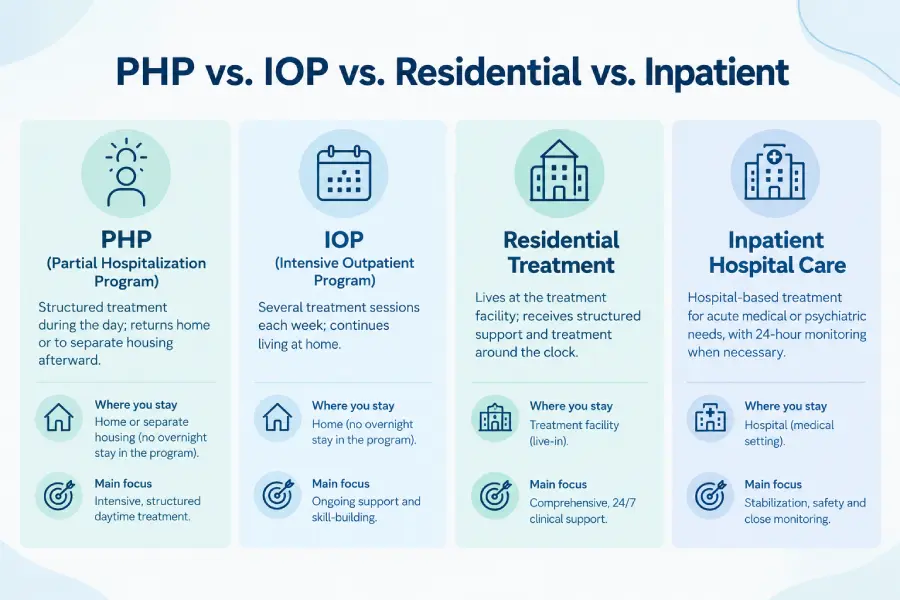
The exact services and schedules vary by program. Insurers may classify or cover services differently, so the program name alone does not establish how a particular claim will be handled.
A person who needs medically supervised withdrawal management or acute stabilization may require a different setting before entering PHP or IOP. Conversely, someone who can be treated safely in an outpatient setting may not need hospital-based care.
The important thing is to choose care based on a clinical assessment, not simply on which program appears easiest to get covered. Your treatment team can help you understand the available options and the reasoning behind a recommendation.
Does PPO or HMO Insurance Cover PHP and IOP Differently?
Yes, the rules can differ, although the name of your plan alone won’t tell you exactly what it covers.
PPO plans often offer some out-of-network coverage, potentially at a higher cost to the patient. However, out-of-network benefits are not guaranteed. The plan may impose different deductibles, coinsurance, allowed amounts, or other restrictions.
HMO plans generally emphasize care through an established provider network and may require referrals or care coordination. Specific requirements and exceptions depend on the plan.
Both types of plans may require prior authorization for PHP or IOP. Both may also require documentation showing that the requested treatment meets their medical necessity criteria.
Before starting treatment, ask the insurer:
- Is PHP or IOP covered under my specific plan?
- Is this provider in-network?
- If the provider is out-of-network, what benefits apply?
- Is a referral or prior authorization required?
- What deductible, copayment, or coinsurance applies?
- Are there limits or exclusions relevant to this service?
- What happens if the initial authorization period ends?
If possible, write down the representative’s name, the date of the call, and a reference number. This gives you a record of the conversation if you need to follow up later.
What Can You Do If Insurance Does Not Cover PHP or IOP?
Before deciding what to do next, find out whether the issue is a medical-necessity decision, an administrative problem, a network restriction, or a benefit exclusion.
Depending on the circumstances, you may have several options.
Request reconsideration or appeal. If the insurer has denied coverage on medical-necessity grounds, ask your provider to review the decision and determine whether additional documentation or an appeal may help.
Explore external review when eligible. In Massachusetts, some patients can request an independent review of an eligible health insurance decision after completing an internal appeal.
Ask about other appropriate programs. An in-network program or another clinically suitable level of care may be an option. Any change should be discussed with the treatment team rather than selected solely on price or insurance status.
Request a private-pay estimate. If you are considering paying out of pocket, ask for a written breakdown of the services included, billing frequency, additional fees, payment terms, and cancellation or refund policies.
Explore other financial options. Depending on your circumstances, public coverage, employer benefits, or financial assistance may be worth investigating.
How Can You Check Your PHP or IOP Insurance Benefits in Massachusetts?
Before entering treatment, gather your insurance card, plan documents, and any referral or clinical information available. You can contact your insurer directly or ask the treatment provider to help clarify benefits and authorization requirements.
Use the following checklist to guide the conversation.
Questions for your insurance company
- Does my plan cover PHP and IOP for substance use disorder treatment?
- Are there specific medical-necessity criteria for either level of care?
- Is prior authorization required before treatment begins?
- Do I need a referral from my primary care provider or another clinician?
- Is the treatment program in-network?
- What deductible, copayment, coinsurance, or other charges may apply?
- How are continued-stay reviews handled?
- What is the process for reconsideration, internal appeal, or external review?
- Where can I find the relevant coverage rules and deadlines in writing?
Questions for the treatment provider
- Can you help verify my benefits and explain the authorization process?
- What clinical information may be needed for the insurer’s review?
- How will the team communicate with the insurer about continued treatment?
- What happens if the insurer approves fewer days than recommended?
- Can you explain the likely out-of-pocket costs and available payment options?
These conversations can help you understand the process before making financial commitments. Just remember that benefit verification doesn’t guarantee approval or determine the final amount the insurer will pay.
Conclusion
If you’re exploring addiction treatment in Massachusetts, Shore Point can be a starting point for discussing treatment options, insurance verification, and potential costs. You can also learn more about Shore Point’s treatment programs to understand which options may be relevant to your needs.
You don’t have to figure out every part of the insurance process at once. Start by understanding your benefits, asking what documentation is needed, and getting a clear explanation of any decision that affects your care. If coverage is limited or denied, work with your treatment team to understand your options and decide on the next appropriate step.